
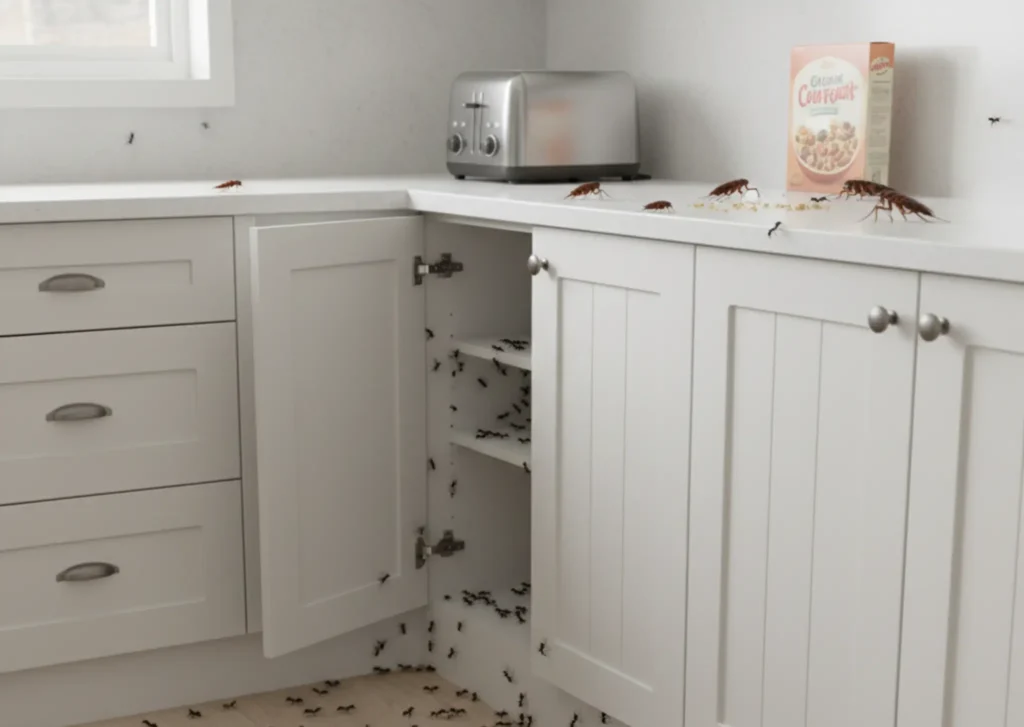
You wipe down the bench at night and it is spotless. You walk in at six the next morning and there is a black line of ants leading to a single sticky spot you missed near the toaster. If you live anywhere along the Tweed Coast, this scene is a Tuesday morning ritual half the year. Here is what we have learned about how to get rid of ants in the kitchen after treating thousands of them across Banora Point, Tweed Heads, Casuarina and Bilambil Heights.
Why Kitchens Are the First Place Ants Show Up
Two reasons. First, kitchens are the only room in your house with a guaranteed daily food supply. Second, they have plenty of small entry points: behind dishwashers, under stove edges, around plumbing penetrations, and along the gap between benchtop and splashback. When we inspect a property, we usually find ant trails entering through one of these points and heading straight for the bin, the pantry, or whatever crumb fell behind the kettle that morning. The ants are not invading randomly. They followed a scout that found something edible.
The First Thing to Do (Before Spraying Anything)
Find what they are eating, and remove the source. Walk along the trail with a torch, find where they are clustering, and clean it thoroughly. A teaspoon of honey under the fridge, a leaking sauce bottle in the cupboard, a pet bowl with overnight kibble: these are the bullseyes. We have seen homeowners spray a trail repeatedly for two weeks while a cracked jar of jam sits forgotten at the back of the pantry. Until that source is gone, you will not get rid of them no matter what you spray.
Why Spraying the Trail Makes It Worse
This is the single biggest mistake we see. You see a trail of ants on the bench, you grab the spray, you wipe out everything visible. Job done, you think. Twenty minutes later they are back, often along a different path, and within a few days the problem feels worse. The reason is that the ants you saw were less than five percent of the colony. The other ninety-five percent are in the nest, and now they know something killed their scouts. They will send more, often by a different route, and may even split into multiple satellite colonies if the spray was a strong repellent.
What Actually Works: Bait, Patience, and a Clean Bench
The way to actually stop kitchen ants is to let foragers carry slow-acting bait back to the colony. A small drop of gel bait near the entry point will be carried home by dozens of ants over a few days, and it will reach the queen. Once the queen is gone, the colony collapses. This means: do not spray the trail when bait is down. Do not wipe the trail away with cleaner. Let the ants do the work. We know it goes against every instinct, but it is how the colony actually dies.
The Easy Wins You Can Do Today
A few small habits cut kitchen ant pressure dramatically. Wipe down the bench with a vinegar and water mix at night, which destroys the pheromone trail the scouts laid down. Put open packets of sugar, flour, biscuits and pet treats into sealed containers. Take the bin out before bed when the weather is warm. Run a damp cloth along the splashback edges where crumbs collect. None of this kills ants, but it makes your kitchen far less rewarding to scout, which is half the battle.
When DIY Will Not Cut It
If you have done all of the above for two weeks and the ants are still coming, the colony is too large or too well-hidden for over the counter solutions. We see this often in older Tweed Heads brick homes where the colony has nested in a wall cavity and is using the kitchen as one of several food sources. We recently completed a job in Terranora where the homeowner had been baiting and cleaning religiously for a month with no result. We located the nest in a wall void behind the dishwasher and treated it directly. Trail was gone within three days.
Kitchen ants are almost always solvable once you stop treating the symptom and start finding the source. If you have been at it for a few weeks with no luck, the nest is probably hidden somewhere a torch will not reach. Have a look at the rest of our ant pest control service or our companion piece on stopping outdoor ants before they head inside, or just get in touch and we will sort it.
Bench Clean, Ants Still Coming?
If the trail keeps coming back, the nest is hidden somewhere you cannot see. We find it, treat it, and your kitchen is yours again.
Frequently Asked Questions
How do I find where ants are coming into my kitchen?
Wait until you see an active trail, then trace it backwards with a torch. Ants almost always enter along an edge: where the splashback meets the bench, where the dishwasher meets the cabinet, where the plumbing comes through the floor. Look for tiny gaps and follow the line until it disappears outside or into a wall void. That is your entry point.
Will vinegar actually keep ants away?
Vinegar destroys the pheromone trail ants use to navigate, which is genuinely useful as a daily cleaning step. It will not kill the colony or stop ants from coming in entirely, but it makes scouting harder and discourages new trails from forming. Wipe down benches and entry points with a 50/50 vinegar and water mix at night.
Should I throw away food the ants have been on?
For sealed packaging that is intact, no, the ants did not get inside. For open food they have walked across or been inside, yes, throw it out. Ants do carry minor bacteria from where they have been and the contamination is not worth the risk for the cost of a packet of biscuits.
How long should it take for kitchen ants to disappear after treatment?
With proper bait-based treatment, you should see trail activity drop noticeably within 3 to 5 days as workers stop returning. Full colony collapse takes 2 to 3 weeks. If you still see active trails after a fortnight, either the bait is not being taken or there is a second colony in play. Either way, it is worth a follow-up call.
Trae
TSD Pest Control is a locally owned pest management business based in Banora Point, serving Tweed Heads and the wider Northern NSW region. Its technicians are licensed and carry out inspections and treatments across homes and businesses — covering termites, ants, cockroaches, spiders, rodents and more — and write these guides to help local property owners manage the pests common to the Tweed Coast.